What Is the Lifting Capacity of a Portable Gantry Crane? — A Comprehensive Analysis and Selection Guide
In industrial production and equipment maintenance scenarios, the portable gantry crane has become an indispensable material handling tool thanks to its flexibility and convenience. However, faced with the wide array of product models available on the market, many users first ask: What is the lifting capacity of a portable gantry crane? This article will provide you with a detailed breakdown of the lifting capacity range, influencing factors, and scientific selection methods for portable gantry cranes.
I. Overview of Portable Gantry Crane Lifting Capacity
The lifting capacity of a portable gantry crane is not a single fixed value, but rather a complete product spectrum ranging from light-duty to heavy-duty. According to market data on mainstream products, the rated load capacity typically falls within the range of 0.5 tons to 16 tons.
Specifically, we can divide them into several common tiers:
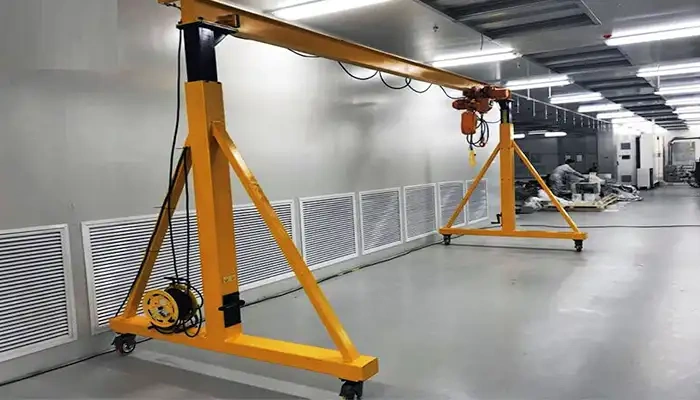
Micro/Light-duty (≤1 ton): Capacity approximately 500kg–1000kg, mostly seen in aluminum folding gantry cranes, suitable for small assembly operations, repair workshops, and confined-space work. For example, certain PRG series aluminum gantry cranes have a maximum capacity of 1000kg.
Medium-duty (1–5 tons): This is the most widely used capacity range for portable gantry cranes and serves as the primary equipment for many mechanical repair and warehouse handling operations.
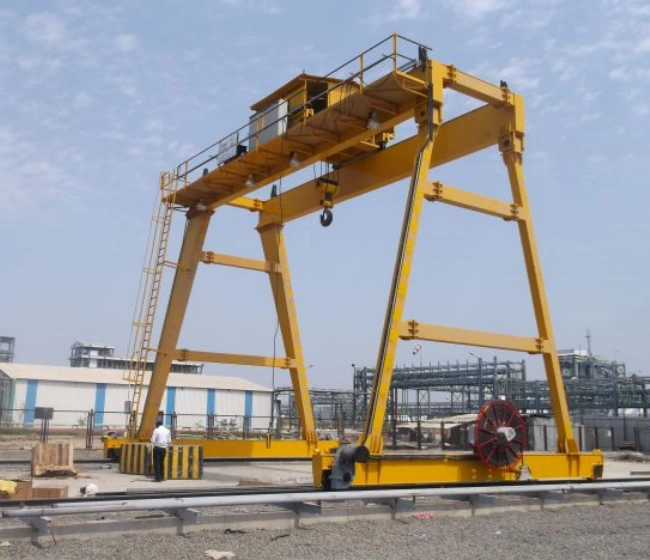
Heavy-duty (5–16 tons): Suitable for heavy industry, large equipment installation, and specialized professional lifting operations.
Understanding the capacity range of a portable gantry crane is only the first step toward correct selection.
II. Key Factors Determining the Lifting Capacity of a Portable Gantry Crane
How much a portable gantry crane can actually lift is not determined solely by the "rated capacity" on the product label; the following core factors must also be considered:
Material and Structure: Portable gantry cranes are typically constructed from high-strength aluminum alloy or steel. Aluminum alloy is lightweight but has a relatively lower capacity ceiling (e.g., 1–3 tons), while steel structures, though heavier, can provide higher lifting capacities (up to 10 tons or more).
Span and Lifting Height: The lifting capacity of a portable gantry crane is inversely proportional to its span (the distance between the legs). The larger the span, the greater the bending moment the beam must withstand, which reduces the actual lifting capacity. For instance, the CALDWELL K90 series can vary its lifting capacity between 2,000 lbs and 16,000 lbs depending on different span configurations.
Weight of Rigging Attachments: This is a crucial factor that is easily overlooked. The lifting capacity of a portable gantry crane refers to the total load below the hook. This means you must include the weight of all attachments such as lifting chains, slings, straps, hooks, spreader beams, etc. in the total weight calculation.
For example, if you intend to use a 2-ton portable gantry crane to lift a 1.8-ton piece of equipment, but the rigging used weighs 300 kg, the total weight would reach 2.1 tons — exceeding the rated capacity and posing a serious safety hazard.
III. How to Scientifically Choose the Right Capacity Tonnage for a Portable Gantry Crane?
Correctly calculating the required capacity is the core of ensuring safety and efficiency. Follow this four-step method to accurately match the lifting capacity of a portable gantry crane to your needs:
Determine the Maximum Load: Identify the heaviest single item you expect to lift in your work scenario — not the average daily load.
Add Attachment Weights: Sum up the weights of all lifting tools, rigging, and accessories you plan to use.
Add a Safety Margin: Increase the total weight from the above two steps by an additional 20%–30% safety margin to account for dynamic shock, off-center loading, and potentially heavier future tasks.
Round Up: If the calculated total weight falls between two capacity specifications, choose the larger tonnage model without hesitation. For example, if the calculation yields 2.2 tons, you should select a 3-ton or 5-ton portable gantry crane rather than a 2-ton unit.
IV. From Entry-Level to Professional: Common Capacity Specifications and Application Scenarios
To help you more intuitively understand how the lifting capacity of a portable gantry crane matches real-world applications, we summarize based on market experience as follows:
1,100 lbs (approx. 0.5 tons): Suitable for light assembly work, small motors, valves, and commercial HVAC component handling.
2,200 lbs (1 ton): The "gold standard" for industrial maintenance. Suitable for medium-sized submersible pumps, compressors, standard industrial motors, and heat exchangers.
4,400 lbs (2 tons): One of the most popular capacity specifications, widely used for wastewater treatment plant equipment, commercial chillers, and installation and maintenance of medium-sized industrial machinery.
6,600 lbs (3 tons) and above: Entering the heavy industrial domain, used for large transformers, heavy machinery transport, and specialized lifting operations.
Conclusion
In summary, the lifting capacity of a portable gantry crane is not simply a product specification, but a decision that requires comprehensive evaluation based on material, structure, attachments, and working conditions. The lifting capacity of a portable gantry crane ranges from a few hundred kilograms to over ten tons. The key to selection lies in accurately assessing your maximum lifting requirements and always reserving a sufficient safety margin. Always remember that when choosing the lifting capacity of a portable gantry crane, it is better to err on the side of a higher rating. This is not only about operational efficiency but also the primary safeguard for ensuring workplace safety.